Punch Needle Embroidery: The Screen-Free Self-Care Habit You Don’t Have to Be Good At
Some nights you don’t need a ten-step self-care routine. You need something to do with your hands that isn’t your phone. That’s basically the whole pitch for punch needle embroidery, and it’s a better one than it sounds.
If you’ve scrolled past those fuzzy, textured wall hangings and wondered how people make them, the answer is refreshingly low-tech. You load yarn into a hollow needle, punch it through stretched fabric, and a loop pops out the other side. Repeat a few hundred times and you’ve got a rug, a pillow, or a slightly wonky floral piece you’re weirdly proud of. No prior stitching skill required. No pressure to get it right the first time, either.
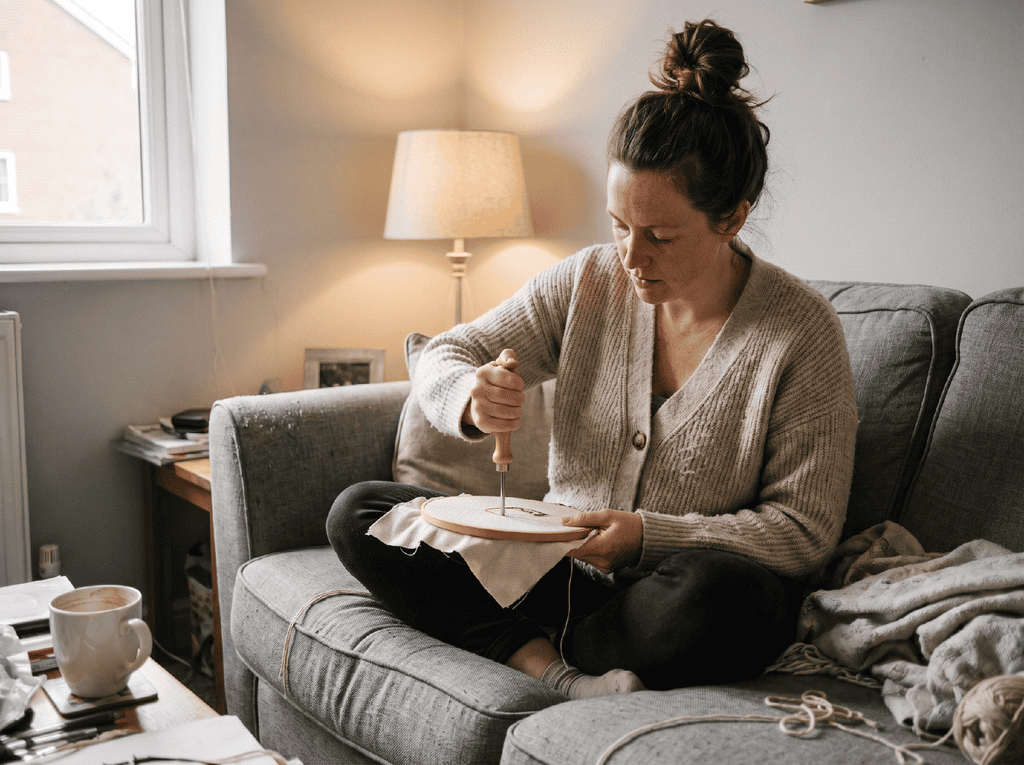
A relaxed evening spent punch needling instead of scrolling – no deadline, no pressure.
Why Punch Needle Embroidery Is Having a Wellness Moment
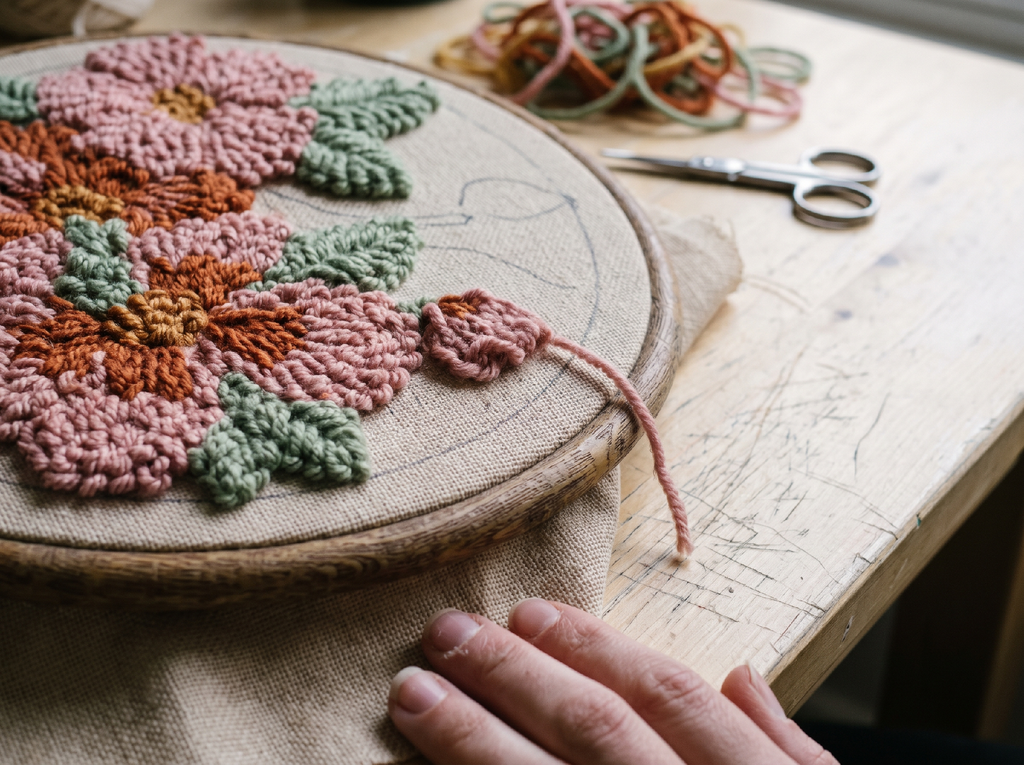
A work-in-progress punch needle piece, loops of yarn building up texture one row at a time.
Punch needle isn’t some niche corner of the craft world anymore. The global punch needle kit market is valued at around $0.4 billion in 2025 and is projected to climb to $0.68 billion by 2034, with North America accounting for roughly 38% of demand, according to a 2025 market report from Marketintelo. That’s a lot of people quietly stabbing yarn into fabric on their couches.
It fits into a much bigger shift, too. Mintel’s 2025 US Arts and Crafts Consumer Report found that 71% of U.S. consumers now identify as crafters, and 73% of adults completed a craft project in the past year. Crafting stopped being your grandmother’s hobby a while ago. It’s now a mainstream, socially acceptable way to decompress that doesn’t involve a screen.
Part of the appeal is how forgiving it is compared to embroidery or cross-stitch. There’s no tiny needle threading, no counting stitches, no unpicking hours of work because you were one square off. You just need fabric, yarn, and a punch needle tool, and honestly, the easiest way to start is to grab a beginner punch needle kit that already has the needle, yarn, and hoop sorted for you. It removes the “wait, what do I even buy” barrier that stops a lot of people before they start.
The Science Behind Why It Calms Your Mind
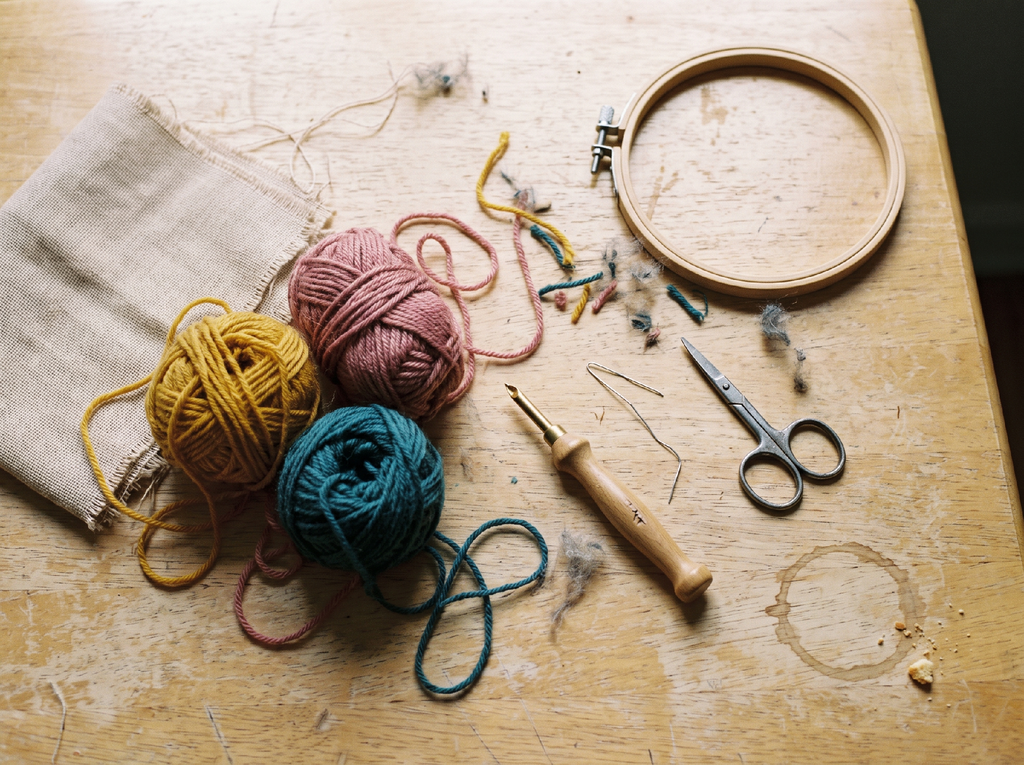
The simple toolkit behind a surprisingly powerful stress-relief habit.
A 2024 UK study out of Frontiers in Public Health, led by Dr. Helen Keyes and involving roughly 7,000 participants, found that crafting’s positive effect on happiness and life satisfaction was actually larger than the effect of being employed. Forbes covered Dr. Keyes’ findings in detail, and the study has since become something of a reference point for researchers looking at crafting and wellbeing.
CNN picked up the same research in September 2024, and the headline said it plainly: making arts and crafts improves your mental health as much as having a job, according to scientists. That’s not a small claim, and it’s not coming from a wellness blog with something to sell you. You can read the full CNN coverage here.
A 2025 network analysis found that craft creation reduces stress and anxiety while building a stronger sense of self through the simple act of finishing something and seeing it come together. The full study is available through NIH’s PMC, and it lines up with what a lot of crafters already say anecdotally: making something with your hands quiets the noise.
A separate feasibility study out of the University of York, nicknamed “Craftwell,” found that hands-on, heritage-style crafting interventions are genuinely workable as a tool for supporting people’s wellbeing, not just a nice idea on paper.
Punch needle in particular leans into a rhythm that seems to matter here. The motion is repetitive: punch, pull back slightly, move over, punch again. It’s the kind of steady, bilateral movement that shows up in techniques used for anxiety and trauma processing, minus any of the clinical framing. Your hands are busy, your eyes are focused on one small area of fabric, and your brain gets a break from whatever’s looping in it. If you’re after other tactile ways to manage stress, the mechanism is similar to a lot of grounding techniques that ask you to focus on physical sensation instead of thoughts.
How to Get Started Without the Perfectionism Trap
This is the part where a lot of craft tutorials lose people, because they make it sound like you need a steady hand and an art degree. You don’t.
Start with a simple design. A single flower, a wavy line, an abstract blob you decide is “modern” after the fact. Monk’s cloth is the standard fabric because it’s forgiving and holds loops well, and most beginner kits use a medium-sized needle that’s easier to control than the tiny fine-gauge ones. Your loops will be uneven at first. That’s normal, not a sign you’re doing it wrong.
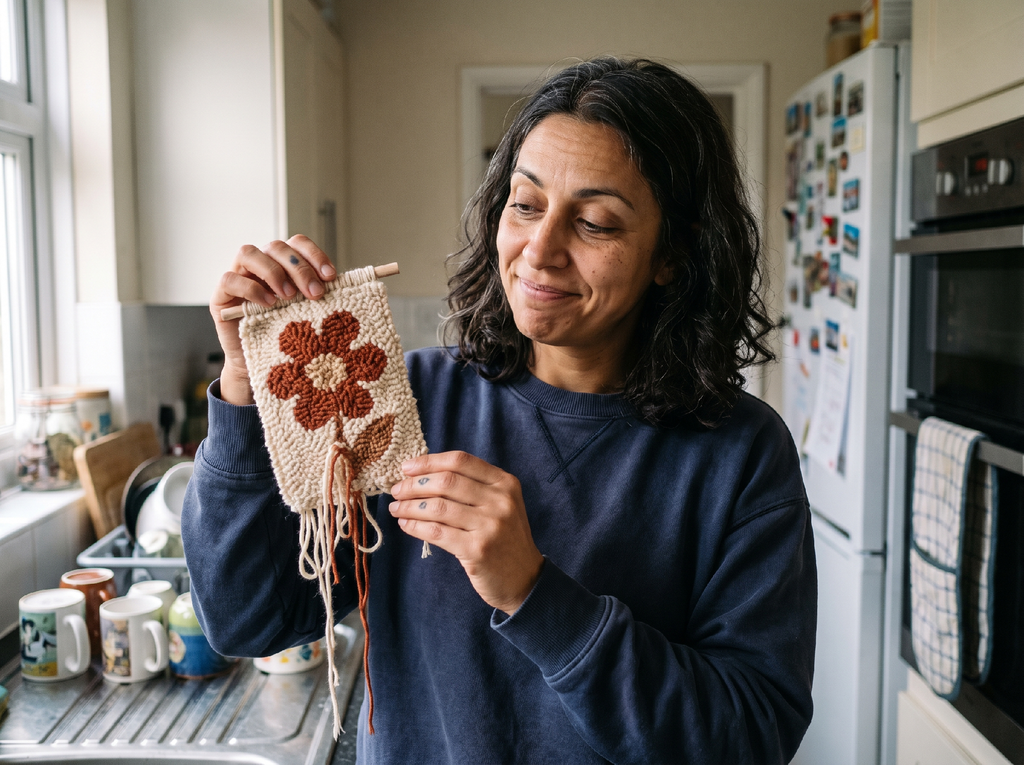
Here’s the actual reframe worth holding onto: this doesn’t need to be good to count as self-care. It doesn’t even need to be finished. If you punch for twenty minutes and stop halfway through a petal, you still got the benefit. The same self-care mindset applies here as it does anywhere else in your life where you’ve decided “done” matters more than “perfect.”
Making It a Realistic Self-Care Habit
Done is better than perfect – the finished piece doesn’t need to be flawless to count as self-care.
The easiest way to keep this going is to stop treating it like a project with a deadline. Twenty minutes with a podcast on is plenty. You don’t need a dedicated craft room or a weekend cleared out.
Some people find it works better with a bit of company, even virtual. Online punch needle communities and the occasional local crafting meetup can turn a solo hobby into something a little more social without adding pressure. Either way, it’s worth thinking of this as one small tool in a wider kit, not a replacement for therapy, movement, sleep, or whatever else is actually keeping you steady. It’s a low-effort add-on for the nights when you want to do something with your hands instead of nothing at all.
The Takeaway
Punch needle embroidery isn’t going to fix a bad week on its own, and it doesn’t need to. What it offers is small and specific: twenty screen-free minutes, a repetitive motion that quiets your head a bit, and a finished (or unfinished) thing to show for it. Given what the research says about crafting’s effect on mental wellbeing, that’s not nothing. It might be exactly the kind of low-stakes habit that’s easier to actually stick with than the big, ambitious self-care routines you keep abandoning by January.