
Optifast Diet UK: How It Works & My Experience
This article features a review of Nestle Optifast diet and meal replacement products by Optifast and includes affiliate links. The views and experiences expressed in this selection of products, including Nestle Optifast meal replacement shakes on sale, are solely my own.
When I was approached by Optifast (made by Nestle Health Science) to try out their meal replacement diet I must admit I was a little sceptical. We all know I like my food and I hate to feel hungry.
I have tried quite a few different approaches to losing weight over the years, and Optifast was one of the more unusual ones for me because it involved replacing some or all of my normal meals.
I originally went into it thinking I would follow the full Optifast programme for six weeks. That didn’t quite go to plan! I discovered very quickly that there is a big difference between liking a meal-replacement product and liking the idea of replacing your meals.
I actually found many of the Optifast products surprisingly filling and there were flavours I genuinely enjoyed. What I struggled with was not sitting down to eat normal food. I missed meals and the process of making dinner.
Most of all, I didn’t particularly enjoy sitting with my family while they ate a meal and I had a shake. So I adapted what I was doing and used Optifast as a partial meal replacement instead.
If you’re considering the Optifast diet, here’s how the programme works, what eating meal replacements was really like for me and the things I’d consider before deciding whether it’s right for you.

What is the Optifast diet?
Optifast is a range of nutritionally formulated meal-replacement products designed to be used as part of a weight-management programme.
Rather than simply being protein shakes, the products are intended to replace meals and therefore contain a combination of protein, carbohydrate, fat, vitamins and minerals.
Depending on the programme you’re following, Optifast can be used to replace some or all of your usual meals for a period of time.
That distinction matters.
Having a meal-replacement shake for breakfast because mornings are hectic is very different from following a total diet replacement programme where most or all of your normal food is temporarily replaced.
I don’t agree with plans which are a temporary solution. The sort that you suddenly stop and go back to your unhealthy diet afterwards. It’s not worth it, right?

Is Optifast the same as a protein shake?
No, and this is something that’s easily confused.
A protein shake is primarily designed to provide protein. It isn’t necessarily nutritionally complete enough to replace a meal.
A meal replacement is formulated specifically to take the place of a meal and should provide a broader range of nutrients.
So don’t assume that a random tub of protein powder from the supermarket can simply be substituted for an Optifast product.
They serve different purposes.

What can you have on the Optifast diet?
Exactly what you eat depends on the version or stage of the programme you’re following.
Optifast programmes can involve different levels of meal replacement, from replacing all normal meals for a limited period to replacing only some meals alongside ordinary food.
This is one area where I’d strongly recommend following current Optifast guidance rather than an old menu you find on Pinterest or a blog post written several years ago.
Programmes and product ranges can change.
It’s also particularly important to get appropriate professional advice if you’re considering a very-low-energy or total meal-replacement approach and you have a medical condition, take medication, are pregnant or breastfeeding, or have any other reason why substantial dietary restriction may not be appropriate.

Why did I try the Optifast diet?
When I tried Optifast, I was already very familiar with weight-loss plans.
I’d previously lost more than 10 stone with Slimming World, but like many people who’ve lost a lot of weight, my story didn’t simply end when I reached target.
I have tried different approaches since then, and I was curious about meal replacements.
Part of the attraction was simplicity.
There isn’t much decision-making involved when your breakfast is already sorted.
You don’t have to work out calories, plan an elaborate lunch or stand in front of the fridge wondering what you’re going to eat.
On paper, I could see the appeal.
In practice, I learned something quite quickly about myself.
I actually like eating meals.

My first experience of the Optifast diet
I’d originally planned to follow Optifast much more strictly. I thought six weeks sounded manageable. Then I started.
I didn’t necessarily struggle because I was desperately hungry. In fact, one of the things that surprised me was that some of the products were more filling than I’d expected.
My problem was psychological and practical. I missed food. Not in the sense that I desperately needed chocolate or a takeaway. I missed sitting down with a plate of dinner. I missed texture and I missed eating the same meal as everyone else.
Food isn’t only fuel. Meals are part of our routines and social lives, and I hadn’t appreciated quite how much that would matter to me until I removed them.
Why I changed to partial meal replacement
Rather than deciding I’d “failed” because total replacement wasn’t for me, I changed what I was doing.
I found partial meal replacement much easier.
Having an Optifast product at a time when convenience genuinely helped me was very different from replacing every opportunity to eat normal food.
That approach fitted my life considerably better.
It’s also one of the reasons I’m cautious about telling anyone that a particular diet is fantastic simply because it creates weight loss.
You still have to live while you’re following it.
If an approach makes every family dinner, social occasion or normal day feel difficult, you have to ask whether it is realistic for you.

Did Optifast make me hungry?
This was one of my biggest concerns before trying meal replacements.
I expected to be ravenous.
I was pleasantly surprised by how filling some of the products were.
That doesn’t mean nobody will feel hungry on Optifast. Appetite is individual and will also depend on exactly which version of the programme you’re following.
But for me, hunger wasn’t the main reason I didn’t want to continue with total meal replacement.
Missing actual food was.
Those sound like the same thing, but they really weren’t.
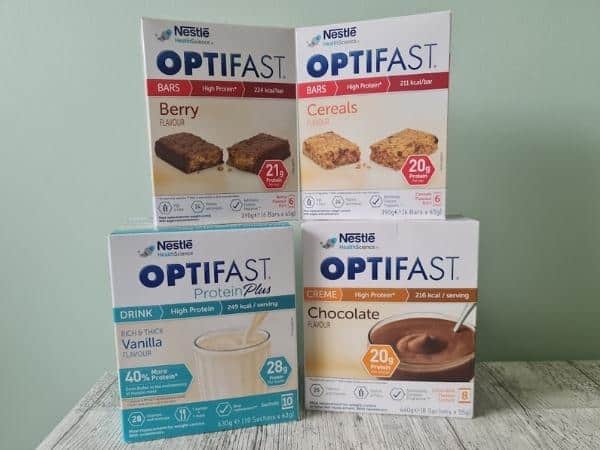
What are Optifast products like?
There are different types of Optifast meal replacements, including shakes and other sweet or savoury options depending on the current range.
I found some much nicer than others, which I imagine is true for almost anyone trying a box of meal replacements!
Taste is incredibly subjective, so rather than turning this guide into 2,000 words about whether I liked a particular shake, I’ve put my thoughts about the actual products in a separate article.
Optifast Reviews – What Do the Shakes, Bars, Soups & Desserts Taste Like?
That’s the page to read if your main question is whether you’re going to open your first Optifast product and immediately regret your life choices.

Is the Optifast diet easy to follow?
From a food-planning point of view, it can be extremely simple. Meal replacements remove a lot of decisions. There is less shopping, less preparation and potentially less calorie calculation. That could be genuinely helpful for someone who finds deciding what to eat exhausting.
But simple isn’t necessarily the same as easy. I found the social and emotional side of replacing meals much harder than preparing the products. Making a shake wasn’t difficult. Watching other people eat dinner while I drank one was.
That’s something I’d consider before committing to a total meal-replacement programme.

What I liked about Optifast
The convenience was probably the biggest advantage for me. There was very little preparation and I knew exactly what I was having. I also liked some of the products much more than I expected to. And despite assuming I’d spend the entire time hungry, I generally found them reasonably filling.
For a busy morning or another occasion when I might otherwise skip a meal or grab whatever happened to be available, I could see the usefulness of a meal replacement.

What I didn’t like about the Optifast diet
I didn’t like completely replacing normal meals. That’s the big one. Food has a social role in my life and I hadn’t really considered that before starting.
I also think very structured programmes can create another problem: eventually you need to decide what happens when the structure disappears.
If you’ve been eating pre-portioned products, returning to normal food means once again making decisions about shopping, cooking, portions and eating habits.
For me, learning how to manage ordinary food is ultimately more useful than becoming excellent at opening a meal-replacement packet.
Can you lose weight with Optifast?
A sufficiently energy-restricted diet can result in weight loss, and structured total diet replacement programmes are used in weight-management settings.
But that doesn’t mean Optifast guarantees a particular amount of weight loss or that everyone should use it.
Your starting weight, overall intake, health, adherence and many other factors matter. I’d be especially wary of dramatic claims such as “lose X stone in six weeks”.
Even if somebody else achieved that result, it tells you very little about what will happen in your body.

What happens when you stop using meal replacements?
For me, this is one of the most important questions. Losing weight is only part of weight management. Eventually, most people want or need to eat ordinary meals again. That means thinking about the habits you’ll need afterwards too.
- What will breakfast look like?
- How will you manage portions?
- What will you cook for dinner?
- How will you handle eating out?
- What will you do when you’re tired and can’t be bothered to cook?
A meal-replacement programme can provide structure, but it can’t make those questions disappear forever.
Is the Optifast diet suitable for everyone?
No weight-loss approach is suitable for absolutely everybody.
This is particularly important with very-low-energy and total meal-replacement programmes because they can involve a substantial reduction in normal food intake.
If you take medication or have a health condition, don’t assume that because the products contain vitamins and minerals the programme is automatically suitable for you.
Get appropriate medical or dietetic advice for your circumstances.
And if you have a history of disordered eating or find restrictive diets affect your relationship with food, that’s something I’d take seriously too.
Would I do Optifast again?
I wouldn’t choose total meal replacement for myself.
Trying it taught me that I value normal meals far too much.
That doesn’t mean I think meal replacements are inherently bad.
I can see circumstances where having a nutritionally formulated meal replacement available could be genuinely convenient.
What I wouldn’t personally want is for shakes, bars or other products to replace the experience of eating normal food for an extended period.
Partial replacement suited me considerably better than trying to replace everything.
Is the Optifast diet worth trying?
That depends enormously on why you’re considering it.
If you’re attracted to the structure and simplicity of meal replacements, I can understand the appeal.
If you’re expecting Optifast to remove the need to ever think about your relationship with food or long-term eating habits, I’d be more cautious.
My biggest lesson from trying Optifast wasn’t really about shakes.
It was discovering that theoretically easy and personally sustainable aren’t always the same thing.
I could follow the instructions.
I just didn’t want to live like that.
And after trying many approaches to weight loss over the years, I’ve learned to pay much more attention to that distinction.

Want to know what the Optifast products taste like?
If you’re already considering the Optifast diet and want to know what I thought of the individual products, I’ve reviewed the shakes and other products I’ve personally tried separately.
Read my Optifast product reviews
That article is about the products themselves; this one is about my experience of the diet and meal-replacement approach.
Did I lose weight on the Nestle Optifast meal replacement diet?
So, the bit you are probably wondering most about, did I actually lose any weight. The simple answer is yes. I have gained a lot of weight this last year due to depression and generally being a bit greedy.
Without losing a few stones, I don’t think you would see the difference in comparison photos. If I am being honest, I don’t like how I look, so I prefer not to share them yet anyway.
I did, however, lose a whopping 7 lbs in the first week and 5.5 lbs in the second week. Please bear in mind that this is my own result, and for anyone looking to try the Nestle Optifast meal replacement plan, you should expect your own results, as everyone is different.
The first week consisted of one full day of meal replacements and no additional food. This was followed by 6 days of replacing one or two meals with a meal replacement. I was ensuring that the other meals were healthy and low-calorie, as advised.
My second week was predominantly spent replacing just one meal a day with Nestle Optifast diet meal replacement products, so I wasn’t expecting as much of a loss and was pleasantly surprised.
I possibly could have actually lost more if it weren’t for Ben making an absolutely delicious Victoria sponge cake. Of course, it would have been rude not to enjoy it!
Throughout the week, I had three large slices of the cake, yet I still lost 7 pounds. I am very pleased with that. I would much rather lose slightly less weight and enjoy it than deprive myself!

Other articles you may find helpful
If you are looking for a new diet to try and are still undecided, check out my full weight loss guide with lots of different plans. A few popular ones are:
- The Noom Diet
- Second Nature Diet
- Slimming World guide
- Ketogenic diet
- Weight Watchers
- Fast 800
- Do the unthinkable
- Weight loss surgery
- Lighter Life




2 Comments